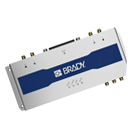
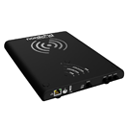
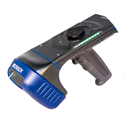
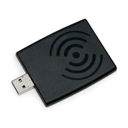
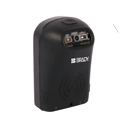
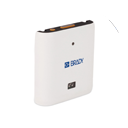
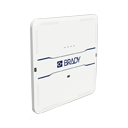
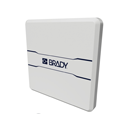
Instantly capture asset data. No line of sight.

Accurate RFID readers and antennas


Shop for RFID readers Get the free guide

Instantly capture asset data

Brady’s robust RFID readers enable you to automatically track and quickly find any RFID-labelled item in your facility.

Your RFID labelled assets, products, components, cables will become legible instantly for automated Internet of Things or Industry 4.0 applications. Inventories, inventory audits, cargo checks, production status, supply chain visibility: all can be automated easily by equipping your items with the right RFID label, fit for your business context.

Fixed RFID readers can monitor entire facility areas or function as gates to automatically update inventories, to share an item’s last seen location, and even to show the direction it was moving in. Portable RFID readers can read, and also write to, RFID labelled items from a distance. On-board sounds and visuals enable users to home in on assets selected on-screen.

Why Brady?

Achieve the highest performance in passive, battery-free RFID read range and RFID read reliability. We develop and build our own RFID antennas, integrated in highly dependable RFID readers, to solve traceability, identification and inventory challenges in manufacturing, logistics, laboratory and retail environments.

Nordic ID Technology

All our RFID readers are equipped with Nordic ID Technology,
a leading RFID solutions brand since 1986.

Discover more

Robust RFID readers

Dependable, practical, robust. Discover our fixed and portable RFID readers with unique and proprietary antennas.

〉Discover more

Accurate RFID antennas

Accurate, slim, and cost efficient. Our beam-forming and circular polarisation antennas enhance read range and accuracy.

〉Discover more

The right RFID reader

Which RFID reader type does your business application need? Consult our RFID specialists before deciding.
 

〉Contact us

What are RFID readers?

RFID readers can identify hundreds of items and assets every second without needing line of sight. This makes them ideal to monitor inventories, and to read and write to several RFID labelled items simultaneously. An RFID reader is an electronic device with multiple RFID antennas to send and receive radio wave signals that can identify RFID labelled objects from a distance.

At customisable intervals, RFID readers send radio signals through a radio frequency transmitter and RFID antennas. These radio signals are reflected back by RFID labels and RFID tags via backscatter reflection, similar to a radar system. The RFID readers receive information including the RFID label or RFID tag’s unique Electronic Product Code (EPC). The RFID label or RFID tag’s unique code can be linked to a specific item in any inventory, including work-in-progress production, warehouse storage, vehicles and tools, office furniture assets and facility gates or doors in the case of access control applications. In this way, RFID readers can automatically track and collect information on any RFID labelled item within read range.

RFID read range and read accuracy are determined by the RFID technology (active-passive), frequency of the RFID reader (Ultra High Frequency, High Frequency or Low Frequency), and the RFID label or RFID tag (on-metal or off-metal, label antenna size). Distance between the RFID labels and RFID reader antennas, and metal rich physical obstructions co-determine read range and read accuracy. Because of this, RFID reader setup is best done with expert support.

Automated inventories, automated access control, automated cargo checks, anti-theft and anti-counterfeit applications, asset localisation, asset status and even automated asset environmental data can be enabled by RFID readers. The highly accurate, automated and real-time data can support decision making both on a tactical and strategic level.

RFID reader types

RFID readers are usually split in two large categories: fixed RFID readers and portable RFID readers.

They can also be categorised by:

  • frequency (low frequency, high frequency, ultra high frequency)
  • UHF frequency range (ETSI, European Union: 865 - 868 MHz and FCC, United States: 902 - 928 MHz)
  • connectivity (Wi-Fi, LAN, Serial, USB, Bluetooth)
  • onboard processing capability and available antenna ports (1 to 16)
 

Fixed RFID readers

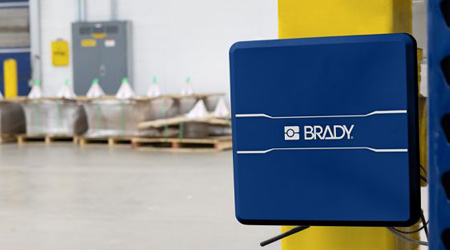
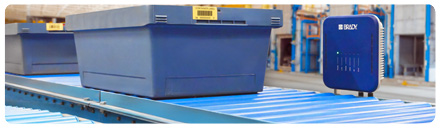
Fixed industrial RFID readers can be mounted on walls, desks, gates, portals and even on vehicles. They can connect 1 to 16 high gain RFID antennas to track any RFID labelled asset in a very specific or larger area.

Fixed RFID readers are used:

  • to automate inventory and cargo checks
  • to monitor stored assets
  • to provide a last seen location
  • to log new pallet locations
  • to share which assets are in maintenance
  • to track work-in-progress production
 

Portable RFID readers

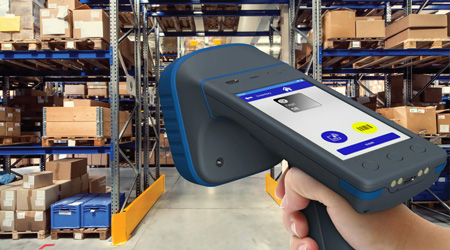
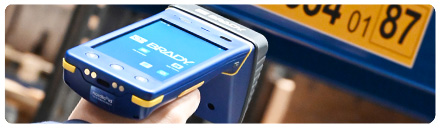
Portable or handheld UHF RFID readers are lightweight and can write to RFID labels or tags by selecting them on-screen from a list of all RFID labelled items in range. They enable users to scan entire rooms while walking. With portable RFID readers, users can also home in on the location of a specific asset with onboard sounds and/or visuals. Portable RFID readers facilitate asset localisation in a wide range of scenarios, including asset maintenance, tool allocation, equipment rental and installation of complex machinery.

Portable RFID readers can be further divided into 2 categories:

  • RFID mobile computing devices which feature an onboard computer.
  • RFID sleds that use a Bluetooth or wired connection to a smartphone or tablet.

RFID reader compliance

RFID readers need to comply with a number of regulations. These can vary per region or country and govern power emission and certification of produced or imported equipment. Some countries also documented how fast RFID applications should hop frequencies within their allocated frequency range, and where RFID can be used.

RFID reader frequency


Compliant radio frequencies can vary per country. Radio frequency bands are typically allocated to specific types of communications on the national level. This allocation avoids interference between various radio applications, including aviation transmissions, satellite and first responder communications.

RFID reader power emissions


When RFID systems exceed their permitted power emission level, they could interfere with other radio applications in close proximity. This interference may include failures to read or even unintended activation of other applications, e.g. a door opening. For this reason almost all countries regulate RFID system power emissions. RFID power emissions are measured as ERP (Effective Radiated Power) or EIRP (Effective Isotropic Radiated Power).

RFID reader safety


Next to avoiding interference, RFID reader compliance is also required for the safety of humans and animals. Like all radio communication technology, RFID emits energy in specific frequencies. The strength of the emitted energy must stay within harmless limits. The Wi-Fi technology we all use every day for example, uses the same frequency as a microwave oven. (2.4GHz). By keeping the signal strength low, certified and monitored, technological advantages can be enabled without creating safety risks.

RFID reader certification


Certification of used, produced and imported RFID readers is required, before they can be used, in most countries.
RFID regulators are organised on the regional or national level. In the EU, the European Telecommunications Standards Institute (ETSI) governs radio frequency compliance. In the US this role belongs to the Federal Communications Commission (FCC).

  • ETSI EN 302-208 (EU): governs shared operation, transmit power, mandatory listen time, continuous transmission time and minimum pause time.
  • FCC part 15 (US): governs frequency hopping, maximum peak output power, energy level exposure limits and power spectral density.
The main relevant standardisation organisations for RFID technology are:
  • International Organisation for Standardisation (ISO)
  • Global Standards 1 (GS1)
  • International Electrotechnical Commission (IEC)
Main standards include:
  • ISO 14223, ISO/IEC 18000-2: low frequency RFID (LF RFID)
  • ISO 15693, ISO/IEC 14443: high frequency RFID (HF RFID)
  • ISO 18000-6C: ultra high frequency RFID (UHF RFID)

Robust RFID readers

See every RFID-labelled asset in range with great accuracy and speed. You will no longer need line of sight to identify and locate your assets.

Our UHF RFID readers are designed to thrive in the toughest manufacturing and warehousing environments.

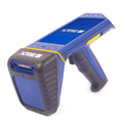
HH86 RFID reader

The HH86 is a rugged RFID reader for item
data collection in challenging industrial
environments like warehouses and factories.

〉Discover the HH86 RFID reader

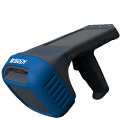
HH85 RFID reader

Easily track assets in industrial environments
with the tough HH85 RFID reader, complete with
large display and practical pistol grip.

〉Discover the HH85 RFID reader

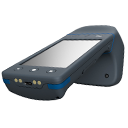
HH83 RFID reader

The HH83 RFID reader is designed for quick,
accurate, and reliable data collection and can
read both barcodes and UHF RFID labels.

〉Discover the HH83 RFID reader

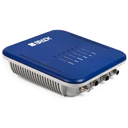
IRX200 RFID reader

Get instant visibility into your work-in-progress
and stock levels with the all-in-one
Brady IRX200 RFID reader.

〉Discover the IRX200 RFID reader

FR22 RFID reader

The FR22 combines fast edge computing, wide
connectivity options and a modular design
to enable highly flexible RFID systems.

〉Discover the FR22 RFID reader

Sampo S3 RFID reader

The Sampo S3 RFID reader combines
reliability, ease of use and speed in
an uncompromising RFID performance.

〉Discover the Sampo S3 RFID reader

EXA81 RFID sled reader

The EXA81 UHF RFID sled reader turns any
mobile phone into a personal radar, locating
in one second tagged items within 15 metres.

〉Discover the EXA81 RFID sled reader

STIX RFID reader enhancement

Stix is an economical credit card-sized
UHF RFID reader sled with easy-to-use USB
connectivity for fast setup.

〉Discover the STIX RFID sled reader

EXA31 RFID reader enhancement

The compact, wearable EXA31 RFID
sled reader easily and reliably connects to
any tablet and smartphone via Bluetooth.

〉Discover the EXA31 RFID sled reader

EXA21 RFID reader enhancement

Lightweight and compact, this ergonomic
reader is the ideal portable RFID
reader for on-the-go data reading.

〉Discover the EXA21 RFID sled reader


High accuracy RFID antennas

We design highly accurate RFID antennas to create high performing UHF RFID readers. Depending on your application, RFID readers with beam forming RFID antennas or with circular polarisation RFID antennas can be supplied.

Beam forming RFID antennas enable longer read ranges by maximising radio wave energy in a specific direction. By combining beam forming RFID antennas, the area can be modified in which RFID labelled assets need to be tracked.
Circular polarisation RFID antennas pick up every RFID labelled item in a circle around the RFID antenna.

BFA RFID antenna

Read a wide area or limited scope
with 28 software controlled beams that
can detect movement direction.

〉Discover the BFA RFID antenna

GA30 RFID antenna

Accurate, fast reading high gain
beam forming RFID antenna, suitable for
any in- and outdoor environment.

〉Discover the GA30 RFID antenna

GA25 RFID antenna

Slim, robust and cost-efficient circular
polarisation RFID antenna that can be
mounted on all surfaces, even metal.

〉Discover the GA25 RFID antenna

SA0408 RFID antenna

Compact and all surface mountable, the
SA0408 RFID antenna is ideal for
environments with size limitations

〉Discover the SA0408 RFID antenna

Sampo S0 RFID antenna

High gain, circular polarisation RFID
antenna designed to easily expand RFID
system reading coverage.

〉Discover the S0 RFID antenna

FA1515e RFID antenna

Thin, any surface RFID antenna with
a unique radiation pattern and consistently
good reading performance.

〉Discover the FA1515e RFID antenna

FA3030e RFID antenna

Great for smart cabinets and shelves,
this thin, unobtrusive RFID antenna can
be mounted on all surfaces.

〉Discover the FA3030e RFID antenna

The right RFID reader & antenna

How to choose the best RFID device for your application? A range of factors help determine the best solution in any given business context. Our RFID specialists can walk you through the selection process.

Discuss the right RFID device with our RFID specialists  


Choosing an RFID reader


To select the optimal RFID reader for a specific application, these factors can be considered:

• How many RFID labels or RFID tags will need to be read at once?

• How many areas will need to be covered by RFID readers?

• Where will the RFID readers be placed?

• Will you use portable RFID readers, or fixed RFID readers? Will these be mounted on a wall, racking,
conveyor belt, or vehicle?

• What is the maximum RFID read range you need?

• How fast will RFID labelled items move through the read zone?

• Will the RFID reader be connected to a network?

• Will the RFID reader need to resist tough conditions like extreme temperatures, humidity or dust?

• In which countries do you plan to use RFID readers?

For fixed readers:

For portable readers:

For RFID enhancements:

Choosing an RFID antenna


RFID antennas differ in polarisation and length, and can be connected at various distances from RFID readers.

• Which RFID reader will you be using?

• Which RFID antennas are you already using?

• How much read range will be needed?

• What are the exact dimensions of the read zones?

• How will RFID labels and RFID tags be oriented versus the RFID antenna?

• How large can the RFID antennas be?

• How far will RFID antennas be placed from the RFID reader?

• How will cable connections between RFID reader and RFID antenna be organised?